
What is your situation in your company?
Your career point
Company Entry
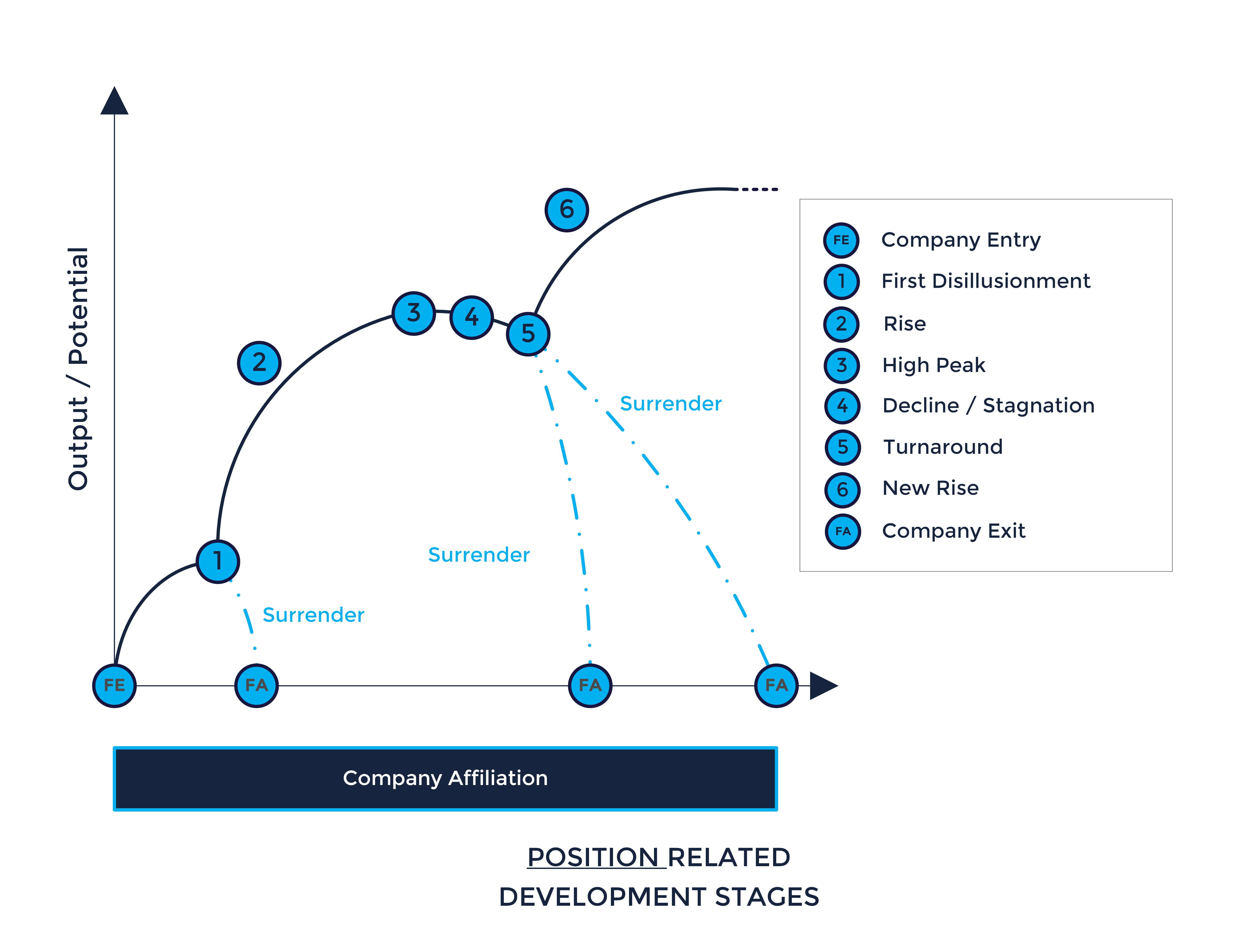
Joining the company is your first career point FE. You have just started at your new company. You are full of drive, enthusiasm and motivation. You can literally feel the joy and drive you exude. You are in a phase in which everything is new and exciting for you. Your goal is to get to know your new colleagues and tasks as quickly as possible in order to prove that you can meet the expectations placed in you.
First disillusionment
The term "first disillusionment" refers to the career point P1 that can occur during or shortly after the induction phase. You can tell whether this applies to you by whether your enthusiasm and momentum from the first few days have faded. Do you have doubts and are you unsure whether your decision to join the company was the right one?
At some point, the initial euphoria always fades. This is why the first phase is often called the "honeymoon" phase. At this point, it is important to classify why people are dissatisfied after only a short time with the company. Was it due to a lack of training or poor, unstructured training? Do you have conflicts with customers, suppliers, colleagues or superiors? Do your own views not match the company's values?
Before you surrender it is useful to find out the trigger for your dissatisfaction.
Rise | Ascent
The longer you work in a company, the more your performance curve rises to career point P2. This is due to the fact that you continuously learn the ropes and thus understand the interrelationships within the company. You know what's important, build relationships with your colleagues and become an integral part of the team. Your good performance earns you the trust and respect of customers, colleagues and superiors. You identify with your company and your tasks and want to take on additional responsibility. However, you still have room for improvement.
High Peak
You have reached your highest level of performance at this stage of development (career point P3) and are thus at the peak of the performance cycle. You are brimming with self-confidence and bask in your successes. You are the guarantor of your team's success and deliver top performance. You act very independently and lead colleagues and employees who seek your advice and see you as a role model.
Decline / stagnation
A form of performance decline (career point P4) can occur directly after a career high. You recognize this by the fact that instead of looking ahead, you are too attached to past success and thus put yourself under pressure. One consequence is that you lack the necessary ease in coping with your work. You become dissatisfied and lose self-confidence. The first doubts about your job germinate and are coupled with thoughts of changing jobs.
However, the trigger for the above spiral does not always have to be triggered by you yourself, but can also find its origin in the corporate environment. You may not have been offered the promised position after your success, or your compensation may not have been adjusted.
Last but not least, stagnation can also occur when too much routine has crept into your processes. Do you feel underchallenged, do you lack variety or do you no longer see any further development opportunities? Do you need more freedom and additional areas of responsibility?
Turnaround
You feel that your performance has declined and you feel uncomfortable. You express doubts about your abilities and are unsure whether you still fit into the company. It is now up to you whether you see the crisis as an opportunity and come out of it stronger. If you do nothing, you run the risk of getting deeper into the negative spiral and falling into a deep hole.
This phase is often referred to as "inner resignation". You fall into a state of indifference and listlessness towards your work and do "duty by the book". For you, your work is only there to earn a living. You seem unmotivated and frustrated, and your performance is average at best. Your own initiative is almost nil. You are reluctant to take on responsibility or you shirk it. You have surrendered characterized by a low level of commitment to your employer. At this point in your career, you need to take action.
New rise
You have taken advantage of the turnaround and realigned yourself within your company. You have taken up new momentum and are once again motivated and full of ideas. This new beginning can have many triggers. Did they give you a raise? Were you accepted into a high potential program? Do they promote your in-service training? Are you being sent abroad as an expatriate? Have you been given an expanded area of responsibility? A new orientation can have many faces.
Company exit
You have decided to leave the company. You are ambitious and high-performing. You want to change your career and look for new perspectives. At this stage, it makes sense not to leave scorched earth behind. Consider how to part fairly and amicably.
"If you don't work to make your dream a reality, someone else will hire you to help them make their dream a reality." Therefore, start to identify your career point now.
Dhirubhai Ambani
 English
  Deutsch